Can you have dental implants if you have gum disease?
Clinically reviewed by Dr Kuldip Gakhal · Principal Dentist · 5 October 2026
A history of gum disease does not automatically rule out dental implants. Active disease needs treating and stabilising first. Your dentist must assess your gums, available bone, medical factors and ongoing care before deciding whether implants are suitable.
Losing a tooth through gum disease can make replacing it feel urgent. The first question is whether the mouth is ready for treatment. An implant consultation should address gum health alongside the missing tooth and the proposed replacement.[1]
Does gum disease always rule out implants?
Previous gum disease and active disease are different situations. Some people with treated, stable gum disease can be considered for implants, but that is an individual decision. Untreated active disease needs attention before implant placement.[1]
The European Federation of Periodontology recommends treating gum disease to a stable condition and establishing supportive care before placing implants. A completed course of treatment does not by itself confirm that this has been achieved; your clinician needs to reassess you.[3]
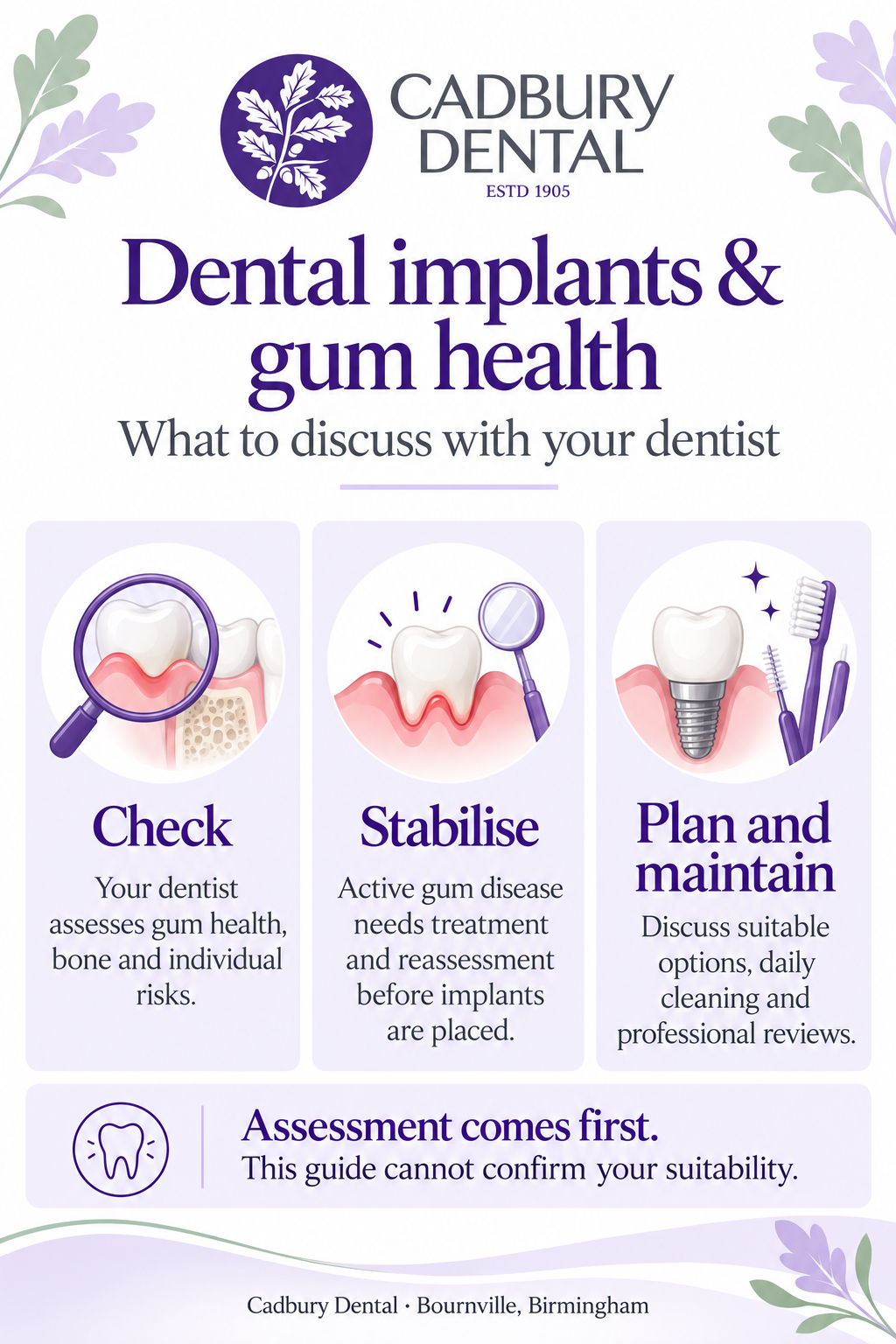
Text version of this image
Cadbury Dental. ESTD 1905. Dental implants & gum health. What to discuss with your dentist. Check: Your dentist assesses gum health, bone and individual risks. Stabilise: Active gum disease needs treatment and reassessment before implants are placed. Plan and maintain: Discuss suitable options, daily cleaning and professional reviews. Assessment comes first. This guide cannot confirm your suitability. Cadbury Dental · Bournville, Birmingham.
What should the assessment check?
| Area to discuss | Why it matters |
|---|---|
| Current gum health | Treatment and reassessment may be needed before an implant plan can proceed. |
| Bone at the missing-tooth site | Examination and appropriate imaging help assess whether the site can support an implant. |
| Medical history and smoking | These can influence healing and the treatment options offered. |
| Cleaning and follow-up | The proposed replacement must be accessible for cleaning and ongoing professional care. |
Bone loss does not automatically mean a bone graft is needed or that one will make implants possible. The amount and position of remaining bone must be assessed. X-rays are used in assessment; more detailed imaging may be needed in some cases.[4]
Tell the team about your medicines, relevant medical conditions, smoking and previous gum treatment. Ask what can be improved before treatment and how your individual risks affect the decision.[3]
Would removing the affected teeth solve the problem?
Replacing teeth with implants does not remove the need to manage gum health. The tissues around implants can become inflamed, and peri-implantitis can involve loss of supporting bone. Discuss whether natural teeth can be retained and compare the benefits and limitations of replacement options.[1]
For a broader comparison, read our guide to whether dental implants are worth it. Treatment suitability comes before a decision about which replacement to choose.
What if your gums are bleeding now?
Bleeding, sore or swollen gums should be checked by a dentist rather than left until an implant consultation. NHS guidance advises an urgent dental appointment for very sore, swollen gums or teeth becoming loose. If you cannot obtain urgent dental care, NHS 111 can advise.[2]
What care is needed after an implant?
Implants need an ongoing cleaning and review plan. The implant restoration should allow effective cleaning, and your team should explain the techniques suitable for it. Professional monitoring remains important even when the implant feels comfortable.[3]
Ask how often you should attend reviews, who will provide maintenance and what changes should prompt contact. Cambridge University Hospitals identifies gum health, smoking and long-term cleaning as factors affecting implant outcomes; there is no guaranteed lifespan for an individual implant.[4]
Discussing treatment in Bournville, Birmingham
Cadbury Dental Practice is at 29 Sycamore Road, Bournville, Birmingham, B30 2AA. Explore our dental implant service or use the implant enquiry route to discuss an assessment. An enquiry is not confirmation of suitability. Bring details of previous gum treatment and ask whether further gum care or a specialist opinion is needed.
Our guide to the stages of implant treatment explains the broader process. Ask for your own written plan, including any preparatory treatment, maintenance and costs.
Dental implants: your questions on this topic
Can I have implants after successful gum treatment?
You may be considered after the disease is stable, but successful gum treatment is not a guarantee of implant suitability. Your dentist must assess the site, your health and ongoing maintenance needs.
How long must I wait after gum treatment?
There is no single waiting period suitable for everyone. Reassessment of gum health, any further treatment and the condition of the implant site determine the next step.
Does gum-related bone loss always mean I need a graft?
No. The remaining bone and proposed implant position need assessment. A graft may be considered in some cases, but it is not automatically required or sufficient to make treatment suitable.
Can an implant get gum disease?
Yes. The tissues around an implant can develop inflammation; peri-implantitis also involves supporting bone loss. Cleaning and professional reviews remain necessary.
Should I book an implant enquiry if my gums are painful or bleeding?
Have symptoms checked by a dentist. Seek an urgent dental appointment for very sore, swollen gums or loose teeth; an implant enquiry should not delay urgent care.
Sources
- [1]Patient FAQs – Dental Implants — British Society of Periodontology and Implant Dentistry. Checked 5 October 2026.
- [2]Gum disease — NHS. Checked 5 October 2026.
- [3]Clinical guideline: prevention of peri-implant diseases — European Federation of Periodontology. Checked 5 October 2026.
- [4]Dental implants in restorative dentistry — Cambridge University Hospitals NHS Foundation Trust. Checked 5 October 2026.
Go deeper