Does professional teeth whitening damage enamel?
Clinically reviewed by Dr Kuldip Gakhal · Principal Dentist · 7 October 2026
Professional whitening is intended to lighten teeth without removing their surface, but it is not risk-free. Sensitivity and gum irritation can occur. A dentist should assess your teeth, gums and proposed method before treatment; a blanket promise that whitening cannot cause harm is misleading.
Lightening teeth does not mean removing enamel
Whitening gel changes tooth colour; it does not involve cutting away the tooth surface. That differs from preparing a tooth for some restorations. A treatment that removes no enamel can still have side effects.[4][2]
Sensitivity and gum irritation can happen
Even dentist-supervised whitening can cause sensitive teeth, sore gums or white patches on gums. Ask your dental team what to do if symptoms develop; contact them if side effects bother you. Do not extend gel use beyond your instructions.[1]
Existing sensitivity needs assessment rather than an automatic promise of a gentler protocol. Learn about how professional whitening is planned before choosing a method.
Text version of this image
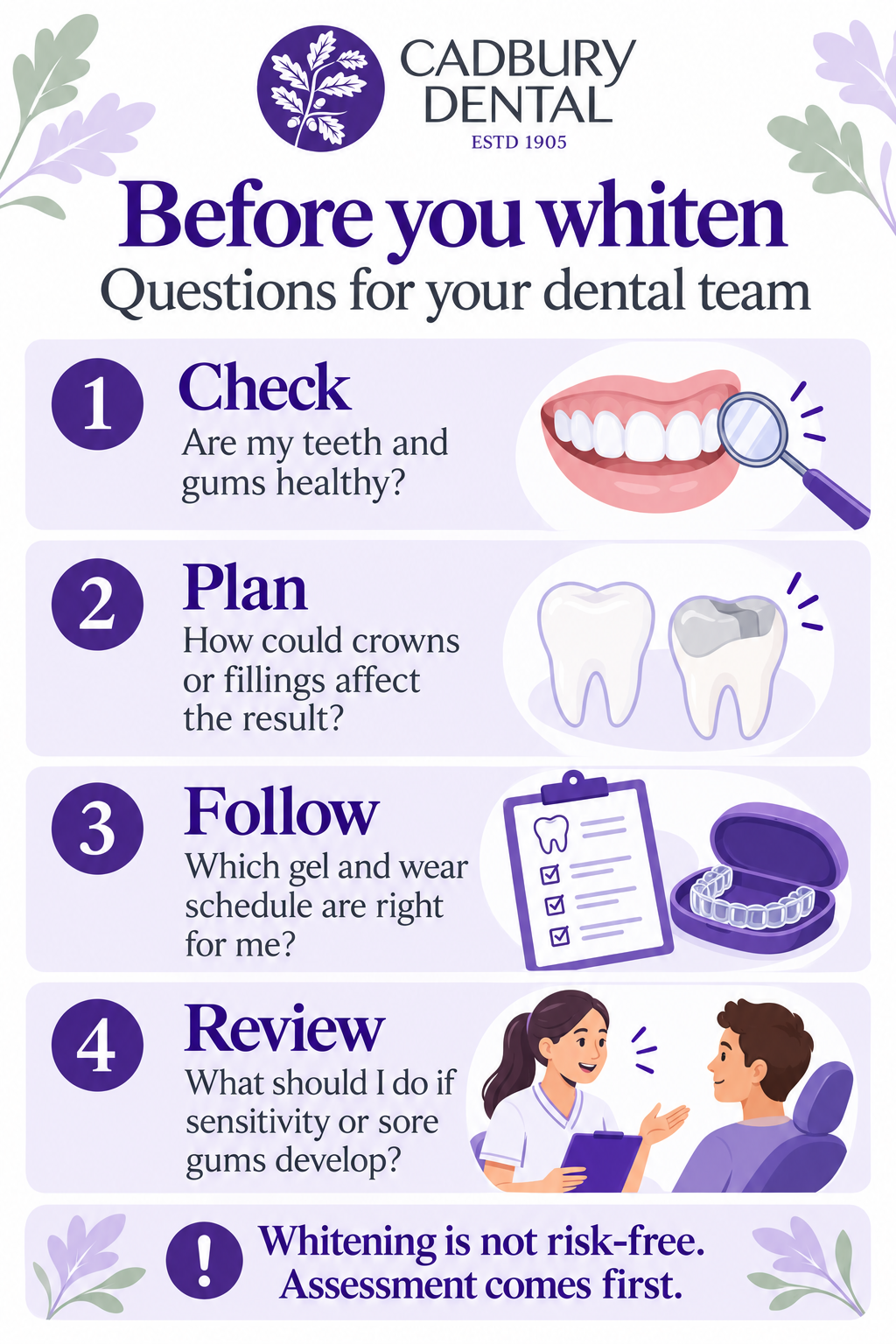
Cadbury Dental. ESTD 1905. Before you whiten Questions for your dental team 1 Check: Are my teeth and gums healthy? 2 Plan: How could crowns or fillings affect the result? 3 Follow: Which gel and wear schedule are right for me? 4 Review: What should I do if sensitivity or sore gums develop? Whitening is not risk-free. Assessment comes first.
Check suitability and existing dental work
Healthy teeth and gums matter. NHS guidance advises against whitening during pregnancy or breastfeeding and does not recommend it for under-18s. Crowns, veneers and fillings keep their colour, so natural teeth may become a different shade.[1][3]
Choose an assessed treatment, or no treatment
A registered dentist must assess suitability and prescribe whitening. Other appropriately registered dental professionals may provide it on that prescription; a beauty salon cannot replace this assessment.[2]
You can choose not to whiten. Cleaning may help surface staining; whitening toothpaste does not produce the same colour change as professional treatment. Discuss any restoration mismatch before committing to additional dental work.[3][4]
Discuss your goals with Cadbury Dental
Cadbury Dental Practice is on Sycamore Road in Bournville, Birmingham.[5] Our teeth whitening page provides the route to discuss your options.
Cosmetic & whitening: your questions on this topic
Can I whiten teeth that are already sensitive?
Tell your dentist first. Existing sensitivity needs assessment; suitability and instructions depend on your teeth and the proposed treatment.
Is whitening advised during pregnancy or breastfeeding?
NHS guidance does not recommend whitening during pregnancy or breastfeeding. Discuss the timing of elective treatment with your dentist.
Will whitening change a crown or filling?
No. These restorations retain their colour while natural teeth may lighten. Discuss a possible mismatch; replacement is not automatically necessary.
Is whitening toothpaste a substitute for professional whitening?
It may help remove surface staining, but does not give the same underlying colour change as professional whitening.
Sources
- [1]Teeth whitening — NHS. Checked 7 October 2026.
- [2]Tooth whitening and illegal practice — General Dental Council. Checked 7 October 2026.
- [3]Tooth whitening — Oral Health Foundation. Checked 7 October 2026.
- [4]Tooth Whitening: information for adult patients — Leeds Teaching Hospitals NHS Trust. Checked 7 October 2026.
- [5]Cadbury Dental Practice: map and contact details — Care Quality Commission. Checked 7 October 2026.
Go deeper